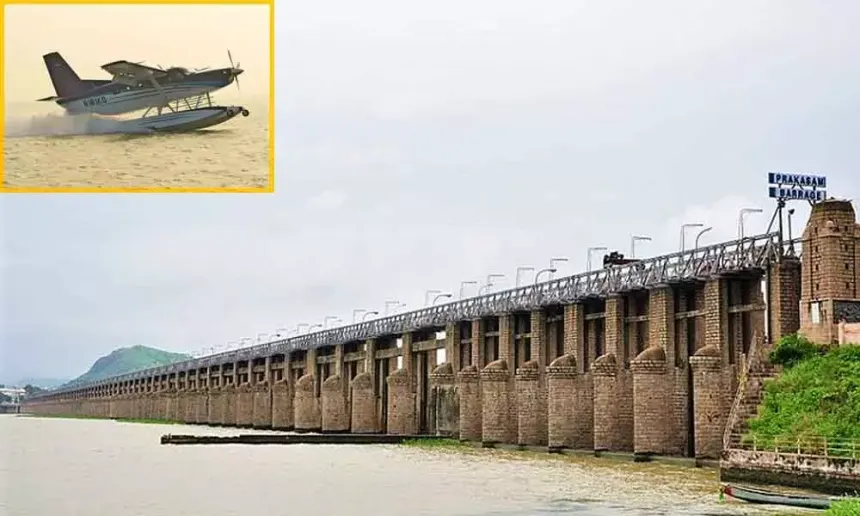
The Human Rights Forum (HRF) demands that the Draft Environmental Impact Assessment (EIA) report for the proposed Water Aerodrome at Prakasam Barrage on the Krishna River in Vijayawada be withdrawn immediately and that the project be sent back to the drawing board. We also demand that the scheduled public hearing on May 21. 2026, be cancelled.
HRF has examined the Draft Environmental Impact Assessment (EIA) Report, prepared by M/s Enviro Resources, for the Andhra Pradesh Airports Development Corporation Ltd. (APADCL), and placed in the public domain in April 2026, for a public hearing scheduled to be held on 21 May 2026. We find the document to be extremely careless, internally inconsistent, and very silent on the single most important hazard at the site- flooding.
The proposed aerodrome is to be built within the reservoir of Prakasam Barrage, immediately upstream of the barrage gates, at the heart of Vijayawada city. This is the same stretch of the Krishna River that discharged approximately 33,000 cubic metres per second on 1–2 September 2024- the highest flow in the barrage’s 70-year history. All 70 crest gates were lifted, road and pedestrian movement across the barrage was suspended, over 35 people died in the NTR district, and more than 2.7 lakh residents of Vijayawada were directly affected. That this is the chosen site for a floating aviation facility- and that the EIA report manages not to notice the flood risk- is astonishing.
The Draft EIA reads as if large portions of it were copied from an EIA for a different project and inadequately re-adapted. Specific errors include:
- Site elevation is reported as 823 to 1,096 metres above Mean Sea Level. This is comparable to a Himalayan hill station such as Solan or Ranikhet. In reality, Prakasam Barrage stands at a Full Reservoir Level of about 17.39 metres MSL, in the Krishna delta plain.
- The main river of the district is named the Godavari. NTR district, which is essentially the former Krishna district, is drained by the Krishna River. Godavari does not flow through it. Prakasam Barrage itself is the barrage across the Krishna.
- The site is described as ‘remote and hilly terrain of the Eastern Ghats’ and a ‘remote tribal region’. Prakasam Barrage is in the centre of Vijayawada, a city of more than one million people. The EIA’s own tables record a population density of 3,813 people per square kilometre in the study area. There is no tribal-reserve zone at the site.
- The running header on every page of the report says ‘Gollapudi’,while the cover page and chapter headings say ‘Prakasam Barrage’. The proponent and the consultant appear not to agree on the name of the project location.
- The statutory environmental-sensitivity checklist (Table 2.2) answers ‘No’ to the question of whether the site is susceptible to natural hazards, including flooding. Only seismicity is admitted. On a site that has just recorded the single largest flood event in the 70-year history of the barrage, this is not an oversight; it is a denial.
If a consultant cannot get the height, the river, the terrain and even the name of the site right, the EIA cannot be treated as a reliable basis for any clearance decision.
The Terms of Reference (ToR) issued by the Ministry of Environment, Forests and Climate Change (MoEFCC) Expert Appraisal Committee on December 22, 2025, specifically directed the proponent to compile 100-year Highest Flood Level data for the Krishna at the site and to design flood mitigation measures accordingly. To this, the draft EIA responds with one sentence: The data, as suggested, has been considered. No HFL figure in metres MSL, no flood-inundation map, no design flood discharge curve, no debris-loadingstudy, no minimum-distance opinion from the National Dam Safety Authority, and no freeboard analysis for the floating pontoon or gangway appears anywhere in the 319-page document.
The same Draft EIA marks nearly every critical safety clearance as ‘under process’ at the time of public consultation: the No-Objection Certificate from the Irrigation & Flood Control Department, the clearance from the National Dam Safety Authority on minimum distance from the barrage rim, the site approval from the Ministry of Civil Aviation, the environmental-parameter compliance from the DGCA, the Forest Department certification, the sedimentation study, and even the need assessment from the Tourism Department. A public hearing held without these opinions is a public hearing about nothing.
We also note that in August 2019, a 20-tonne sand-mining boat lodged in Gate No. 68 of the barrage, and on 2 September 2024, multiple sand boats struck Gates 3, 4, 67, 68 and 69, breaking the counterweight of Gate No. 69 into two pieces. Floating debris of this kind is a recurring fact of life at Prakasam Barrage. A concrete docking pontoon and a seaplane moored in the same reservoir are directly exposed to such collisions. The EIA’s risk chapter does not mention this hazard at all; it instead devotes several pages to tsunamis, which cannot physically reach a barrage reservoir 65 km inland.
It is also to be noted that India’s first and so far, only scheduled water aerodrome, inaugurated by the Prime Minister on October 31, 2020, between the Statue of Unity at Kevadia and the Sabarmati Riverfront in Ahmedabad, ran for only 80 days before it was suspended on April 10, 2021, and formally terminated in April 2023. The Gujarat Civil Aviation Minister disclosed in the Assembly that the service carried 2,192 passengers over 276 flights and that the state spent Rs 13.15 crore, with a further Rs 22 crore allocation largely unspent. The reasons cited were the prohibitive cost of operation, foreign aircraft registration requiring servicing in Malaysia, and commercial unviability.
Of the fourteen water aerodromes awarded under the Ude Desh Ka Aam Naagrik (UDAN) scheme, with Rs 287 crore sanctioned, not a single one on an Indian river is operational today. The working commercial seaplane services that the Draft EIA cites as inspiration, Vancouver’s Harbour Air, Trans Maldivian Airways, Seattle’s Kenmore Air, operate on hydrologically stable waters: protected coastal harbours, atoll lagoons, and lakes whose levels are stabilized by locks. None of them operates on an active river flood reach immediately upstream of a barrage whose gates have been fully opened twice in the last fifteen years.
The Draft EIA projects 41,040 passengers per year for the Prakasam aerodrome by simple multiplication: four trips a day, nineteen seats, two directions, 270 non-monsoon days. There is no demand study, no willingness- to-pay survey, no fare-sensitivity analysis, and no engagement with the Gujarat ridership (which averaged about 27 passengers a day in its brief window). Vijayawada already has a full-service commercial airport at Gannavaram, 20 kilometres away, with daily jet connections to Bengaluru, Chennai, Hyderabad, Delhi, Mumbai and Visakhapatnam.
The 2024 Vijayawada floods killed residents, displaced over 270,000 people, damaged infrastructure across more than half the city, and broke a counterweight on the barrage itself. It is the living memory of the people of Vijayawada. The least we expect from a consultant writing an EIA for an aviation project on the same stretch of the same river, eighteen months later, is that they acknowledge what happened. That this Draft EIA does not, and that it instead reports the site elevation as a thousand metres high and the district’s main river as the Godavari, tells us how seriously the proponent takes either the site, or the public hearing, or the lives of the people the project is advertised to serve.
HRF is not opposed in principle to regional air connectivity, but we are opposed to public safety being subordinated to publicity. We demand:
- Immediate withdrawal of the present Draft EIA and public disclosure by APADCL and the consultant of how such basic errors came to be in a document of record.
- A fresh, corrected EIA prepared only after the National Dam Safety Authority, the Irrigation Department, the Ministry of Civil Aviation, the DGCA and the Forest Department have given their written opinions, and those opinions have been made public in Telugu and English.
- A full hydrological and hydraulic study for the site, including 100-year and probable-maximum-flood analyses, inundation mapping, debris-impact analysis, including the sand-boat hazard documented in 2019 and 2024, and a clearly defined monsoon removal-and-reinstallation protocol for all floating infrastructure.
- A genuine alternatives assessment that evaluates at least Nagarjuna Sagar, Srisailam, Somasila, Dindi and Pulicat against the Prakasam Barrage site on safety, ecology, tourism and cost. Three ‘alternatives’ within 100 metres of each other at the same barrage is not an alternatives analysis.
- A fresh, re-notified public hearing after the revised EIA has been in the public domain for at least 30 days. The present hearing, if held on the present document, cannot inform an Environmental Clearance decision and should not be held.
- Independent peer review of the revised EIA by a hydrologist from the Central Water Commission, an aviation-safety specialist and an ecologist familiar with the Krishna–Kolleru flyway.
Y. Rajesh (HRF Andhra Pradesh State general secretary)
G. Rohith (HRF Andhra Pradesh State secretary)
Vijayawada,
24.04.2026.