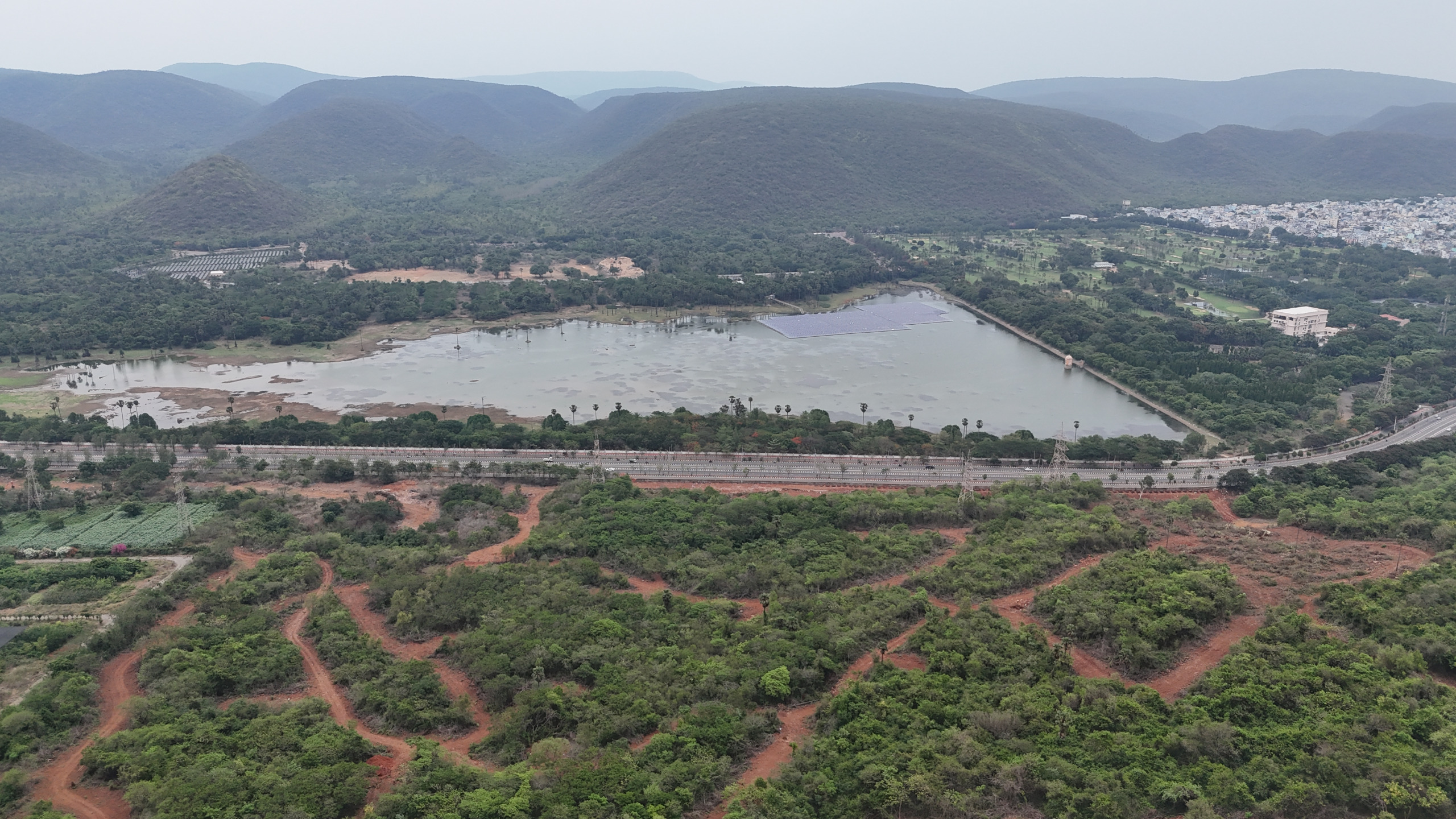
The Human Rights Forum (HRF) condemns the decision of the Andhra Pradesh State Environment Impact Assessment Authority (SEIAA) to grant Environmental Clearance (EC) to the proposed Vizag Hyperscale Data Center Park Ltd project at Adavivaram-Mudasarlova and demands its immediate suspension. We are of the considered view that this clearance amounts to a brazen injustice and is aprofound failure of environmental governance. The clearance was given despite sustained and well-founded objections from concerned citizens, environmental expertsand civil society organisations who have repeatedly warned of the serious ecological, hydrological and social consequences of permitting a project of this scale in an environmentally sensitive area linked to the Mudasarlova reservoir catchment and the Kambalakonda Wildlife Sanctuary. This proposed facility is also to be located in close proximity to the Health City hub and densely populated residential localities, including Arilova and Chinna Gadhili, thereby raising additional concerns regarding public health, environmental safety and urban sustainability. Far from addressing these concerns through rigorous scrutiny and precaution, the grant of EC has reinforced fears that the environmental decision-making process has once again failed to protect the public interest, ecological sustainability and the long-term environmental security of Visakhapatnam region.
Also read:
https://humanrightsforum.org/google-data-center-mou-must-be-made-public/
This is not merely an environmental issue. It is a question of democratic accountability, inter-generational justice and the fundamental right of citizens to a safe and healthy environment. By granting this clearance, the government has clearly privileged the interests of powerful corporate entities over the protection of vital water resources, ecological integrity and the well-being of lakhs of people who depend upon the fragile environmental systems of this region. The decision is particularly disturbing given that hyperscale data centers are among the most resource-intensive forms of infrastructure, consuming enormous quantities of energy and water while imposing significant environmental burdens. Concerned authorities have failed to convincingly demonstrate why a project of this nature should be permitted in a location whose ecological and hydrological significance has been repeatedly highlighted by citizens and environmental groups.
Perhaps the most disturbing aspect of the Environmental Clearance granted on June 10, 2026 is what it does not acknowledge. The central concern raised by citizens,from the very beginning, has been the location of the project in an area intrinsically linked to the catchment system of the Mudasarlova reservoir, an important drinking water source for the city. The project site itself lies just 120 metres from the reservoir.One would expect a project proposed in such a location to be subjected to the highest level of scrutiny, with a detailed examination of its implications for drainage patterns, surface runoff, groundwater recharge, watershed integrity and long-term water security. Yet, the clearance is conspicuously silent on these fundamental concerns. This omission is not a minor deficiency; it goes to the very heart of the environmental concerns surrounding the project and raises serious questions about the adequacy and credibility of the appraisal process itself.
Also read:
https://humanrightsforum.org/google-data-center-represents-a-looming-environmental-economic-disaster-hrf/
HRF is asking a simple question: If the project’s location in relation to the Mudasarlova catchment is indeed of no consequence, why has this issue not been squarely addressed and scientifically rebutted in the clearance itself? Conversely, if it is indeed relevant, as we have consistently maintained, how can any environmental appraisal be regarded as complete, credible or legally defensible without a comprehensive, transparent and scientifically rigorous assessment of the risks posed to a critical reservoir catchment, the tributaries flowing from the Kailasa forest hill and consequently, to the reservoir itself? The EC offers no answer. Its silence on this fundamental issue is not merely an omission; it is a serious flaw that undermines the legitimacy of the appraisal process.
Equally perturbing is the extraordinary lack of transparency that has characterised the entire approval process for these hyperscale data centers. Decisions with far-reaching implications for the environment, water security, energy consumption and the future development trajectory of this region are being fast-tracked without placing adequate information in the public domain and without any meaningful public consultation commensurate with the scale and significance of what is proposed. Citizens have repeatedly sought clarity on critical issues, including the project’s environmental implications, water requirements, energy demand and cumulative impacts, yet critical information has remained inaccessible, unavailable or insufficiently disclosed. Such opacity is incompatible with democratic governance and informed environmental decision-making. The manner in which this project has been pursued raises legitimate concerns that transparency, accountability and public scrutiny have been treated as impediments to be managed rather than essential requirements of a credible environmental appraisal process.
https://humanrightsforum.org/suspend-environmental-clearances-to-hyperscale-data-parks-hrf/
HRF also wishes to emphasise that the concerns regarding this project did not begin with the grant of Environmental Clearance. For several weeks, citizens and environmental groups have drawn attention, with visual proof, to reports of fairly extensive ground levelling, vegetation clearance, tree felling and other site-development activities on the Kailasagiri forest hill. These activities, expressly forbidden in law, were being undertaken from at least February this year, several months before the Environmental Clearance was obtained. Instead of treating these allegations with the seriousness they deserved and conducting a rigorous independent inquiry into possible violations, the authorities have now proceeded to grant clearance to the very project around which these illegalities arose. This creates the deeply troubling impression that environmental compliance is being reduced to a post-factoformality, with projects permitted to advance on the ground first and regulatory approvals expected to follow later.
Also, the broader policy direction being aggressively pursued by the State Government is disturbing. Even as serious concerns are being raised regarding the environmental and hydrological implications of the Adavivaram-Mudasarlova projectas well as the data center projects at Tarluvada and Rambilli, the State governmentcontinues to publicly advocate the establishment of more and more hyperscale data centers in and around Visakhapatnam. This relentless pursuit of data-center expansion appears to be proceeding without any transparent assessment of the cumulative environmental, energy and water costs that such a concentration of infrastructure will impose upon the region. This concern becomes even more acute when one considers the scale of expansion now being publicly contemplated.
Also read:
https://humanrightsforum.org/brazen-illegalities-at-proposed-adavivaram-data-center/
Including the proposed Reliance data-center project near Bhogapuram, proposals currently taking shape in the Vizag region already account for 4 GW of data-center power demand. Yet, government representatives continue to speak of scaling this up to an astounding and alarming 6 GW. A demand of this magnitude is unprecedented and raises questions regarding where requisite power will come from?What new generation and transmission infrastructure will be required? What pressures will be placed upon already stressed water resources and what environmental burdens will ultimately be imposed upon the region?
All this is being advertised without any serious and informed public debate on the environmental carrying capacity of the region. No comprehensive cumulative impact assessment has been undertaken. No transparent study has been placed before the public examining the consequences of clustering multiple hyperscale data centersin a geographically confined area already burdened by industrialisation, environmental degradation and increasing pressure on natural resources. This is ecological recklessness masquerading as technological progress.
HRF believes that the struggle to protect Mudasarlova is about far more than a single project. It is about safeguarding the future of a city already burdened by the cumulative consequences of decades of environmentally destructive and poorly planned industrialisation. Vizag simply cannot withstand further assaults on its fragile ecological systems. The integrity of the Mudasarlova reservoir catchment, once compromised, cannot easily be restored. The resulting consequences are often irreversible and are invariably borne not by project proponents, but by ordinary citizens and future generations.
HRF demands immediate suspension of the Environmental Clearance granted to the Vizag Hyperscale Data Center project and full public disclosure of all studies, reports, expert assessments, correspondence and other materials relied upon in the decision-making process. We believe an independent review of the project must be conducted by a panel of hydrologists, environmental scientists and public-interest experts unconnected with either the project proponents or the government agencies involved in granting approvals. A comprehensive cumulative environmental impact assessment of all existing and proposed projects in the Visakhapatnam region must be undertaken before any further clearances are considered. There must be a thorough investigation into the pre-clearance site-development activities at the Vizag Hyperscale Data Center site and appropriate action initiated against violators. Finally, the State Government must urgently put in place robust legal, regulatory and policy safeguards to protect the Mudasarlova reservoir catchment and other ecologically sensitive and hydrologically critical areas from environmentally hazardous, resource-intensive and high-impact projects. The protection of vital water sources and ecological commons cannot be subordinated to commercial interests.
Y Rajesh – HRF AP State general secretary
VS Krishna – HRF AP&TG Coordination Committee member
12-6-2026,
Visakhapatnam.