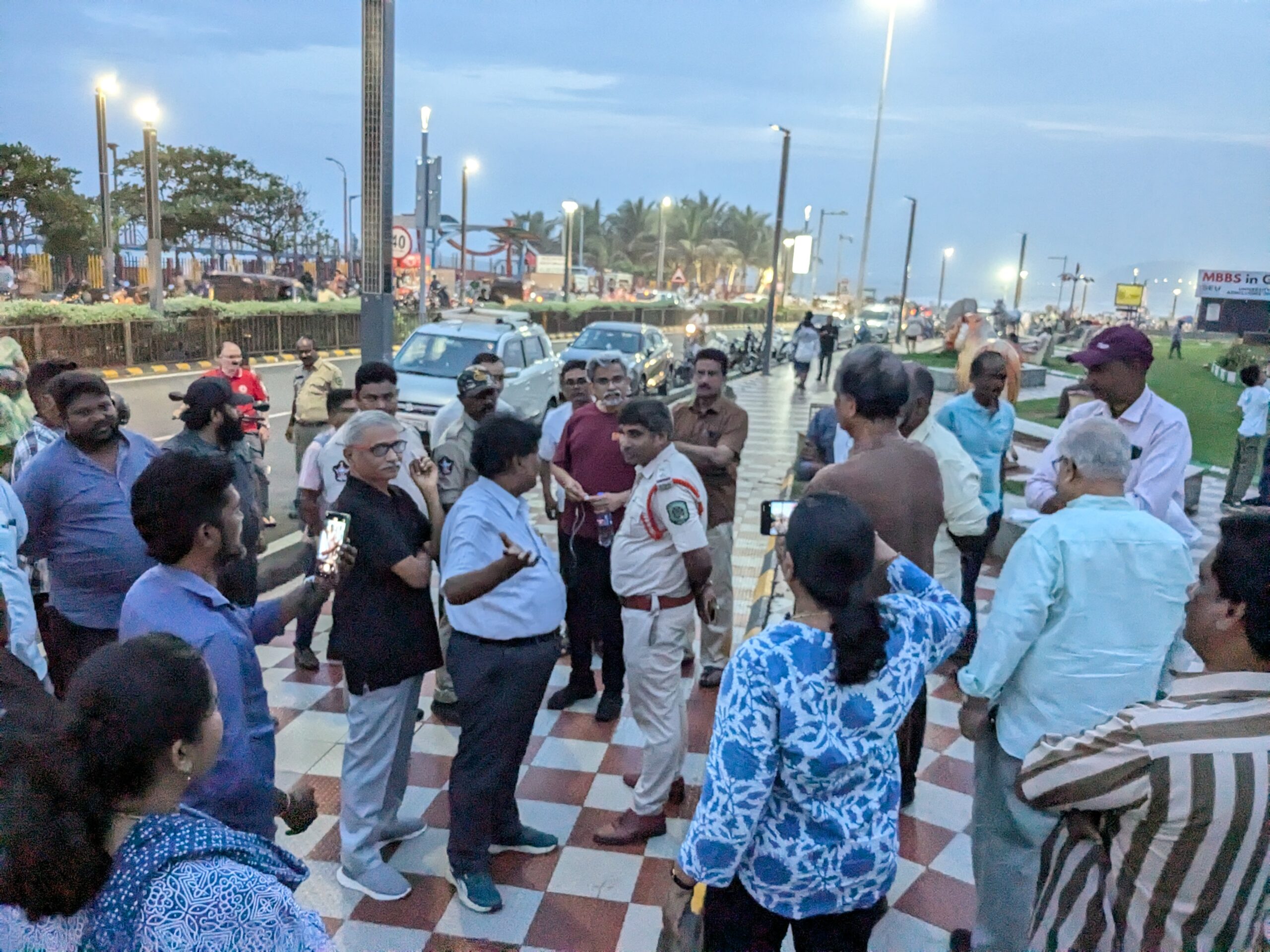
The Human Rights Forum (HRF) strongly condemns the outrageous and wholly unjustified conduct of the Visakhapatnam police in preventing citizens from peacefully campaigning against the indiscriminate proliferation of massive data centers in and around the city.
To mark the anniversary of the Quit India movement, members of the environmental group Green Visakha had called for a peaceful environmental awareness procession on the Vizag beach road for Sunday evening to sensitise citizens to the potentially far-reaching environmental and social consequences of the rash of hyperscale AI data centers being aggressively pushed by the government. The campaign aimed to confront the serious questions arising from the sheer scale and concentration of these projects. It sought to draw attention to the enormous demands on water and power, the intensifying pressure on groundwater and other natural resources, the pollution and waste they would generate and the wider ecological costs of allowing multiple data center facilities to proliferate in and around a city already stretched to its limits in land, water, energy and civic infrastructure.
The police had earlier refused permission for the proposed procession. Yet, when around 20-25 members of Green Visakha and other citizens opposed to the data center projects gathered peacefully at the Bhagat Singh statue, the police arrived and objected even to this modest assembly. The gathering wished to conduct a perfectly legitimate democratic campaign. They wanted to distribute pamphlets and draw public attention to the enormous cumulative environmental, social and economic costs of the data-center projects being pushed through in the region. There was no threat whatsoever to public order, no obstruction to traffic or the public and no disturbance of any kind. Yet the police insisted that the gathering disperse.
The participants, despite having every reason to challenge this arbitrary diktat, chose to comply and agreed to disperse peacefully. But what happened next exposed a disturbing police impulse not merely to regulate a gathering, but to police dissent itself. Before leaving, the participants wanted to take a group photograph in front of the Bhagat Singh statue. A sub-inspector of police responded by telling them: ‘Go anywhere and take a photo, but not here in front of Bhagat Singh’s statue.’
This is an astonishing statement from a police officer. By what law can the police prohibit citizens from merely standing before a public statue and taking a photograph? What conceivable threat to public order could a group photograph possibly constitute? The irony is truly profound. Bhagat Singh’s statue is a public symbol of resistance to injustice and tyranny. Yet citizens standing peacefully before it are apparently to be treated as a threat because they are protesting a plainly retrograde government policy.
This incident cannot be dismissed as an isolated instance of police high-handedness. It comes amid a growing pattern of attempts to restrict public discussion and prevent engagement with people affected by the data-center projects. Over the past several weeks, functionaries of Left political parties were detained when they attempted to visit Tarluvada village to meet residents who had been dispossessed of their land for a data-center project. Why should activists be prevented from meeting people who have lost their land? What possible threat to public order could there be in citizens listening to the grievances of affected communities and seeking to help get them resolved? There has also been an alarming effort to suppress criticism of these projects online, with social media content critical of data center projects being pulled down at the government’s instance. Taken together, these incidents raise a disturbing question. Why is the government seeking to insulate these data-center projects from public scrutiny and trying to intimidate those who question them?
The constitutional guarantees of freedom of speech and peaceful assembly are not privileges that the police may grant or withdraw at will. They are fundamental rights. The State may impose lawful, reasonable and constitutionally permissible restrictions but cannot simply suppress a political campaign it deems inconvenient by denying permission, dispersing citizens and detaining activists. The police are not the arbiters of which political opinions citizens may express, where they may peacefully assemble, or even before which public monument they may take a photograph. Reasonable regulation of public assemblies may sometimes be necessary, but regulation cannot become a pretext for suppressing dissent.
The data-center expansion raises legitimate and urgent questions about land acquisition, displacement, water consumption, electricity, environmental degradation and the diversion of public resources. Questioning these plainly destructive processes is a democratic right and must not be construed as a law-and-order problem. The State cannot answer inconvenient questions with police action nor silence dissent by treating citizens as a threat. HRF demands an immediate end to this police interference with peaceful democratic activity. The government must ensure that citizens are free to campaign, assemble, distribute literature, raise slogans, meet affected communities and express dissent without intimidation or arbitrary police obstruction.
A government that claims its data-center policies serve the public interest should welcome public scrutiny, not seek to suppress it. It cannot defend its policies by deploying the police against citizens who question them. The police may enforce the law, but they do not have the authority to police dissent. In a democracy, the police have no business dictating where citizens may gather, what they may say or whether they may even take a photograph before Bhagat Singh’s statue.
Y Rajesh – HRF AP State general secretary
VS Krishna – HRF AP&TG Coordination Committee member