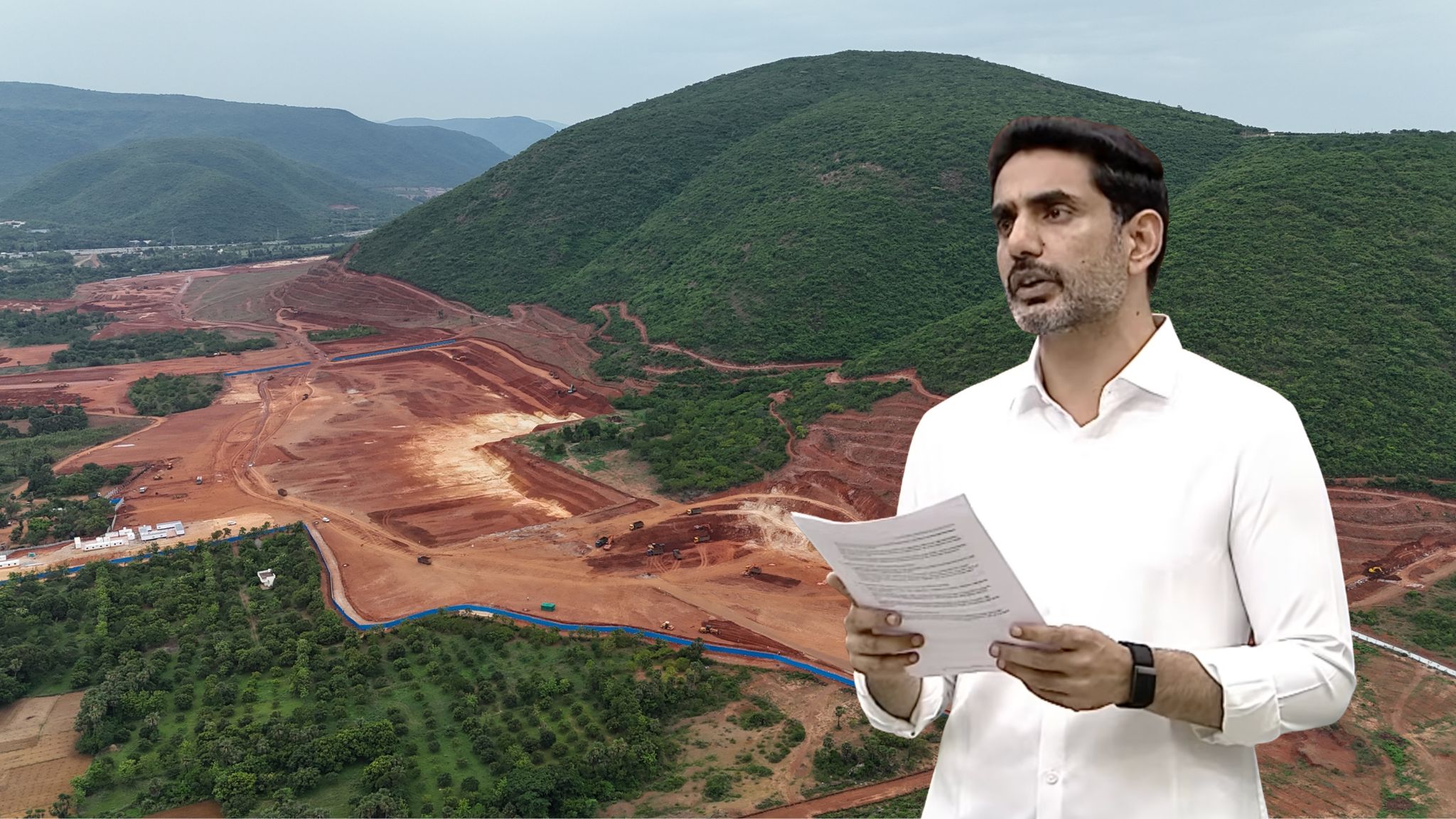
The Human Rights Forum (HRF) rejects Andhra Pradesh IT Minister N Lokesh’s attempt to dismiss growing public concern over the proposed hyperscale AI data centers in Visakhapatnam as “deliberate misinformation”. Speaking in the Assembly on August 19, the Minister also asserted that environmental responsibility would be prioritised and defended the projects’ water and power requirements.
The government’s own record, however, points to precisely the opposite conclusion and the Minister’s assurances do not withstand scrutiny. How was environmental responsibility ‘prioritised’ when a hyperscale AI data center is being established virtually within the catchment of Mudasarlova reservoir, an important source of drinking water for Visakhapatnam? The Google-Adani 512 MW project site at Adavivaram is barely 120 metres from the reservoir. The fundamental question is not whether the project will plant trees later or adopt supposedly efficient cooling technology. It is whether an industrial installation of this scale should be located within the catchment of a drinking water reservoir in the first place.
As HRF has pointed out since May this year, site development and alteration of the Adavivaram landscape began as early as February 2026, months before Environmental Clearance was granted. If environmental concerns were genuinely being prioritised, how was the physical alteration of the reservoir catchment permitted – carried out in brazen disregard of the law – before the requisite environmental scrutiny was completed?
At Tarluvada in Anandapuram mandal of Visakhapatnam district where a 1 GW Google-Adani data center is coming up, extensive hill cutting is taking place in the Pedda Chukka Konda reserve forest area, affecting a landscape whose streams and natural drainage feed downstream water systems, including the Gambheeram reservoir. Large-scale clearing of natural vegetation has also accompanied development for data centers at Rambilli in Anakapalle district. These are not imaginary future impacts. The landscape is already being changed.
Yet projects of this extraordinary scale have been processed under Category B2, thereby avoiding the full Environmental Impact Assessment (EIA) and public-hearing process that would otherwise entail greater environmental scrutiny. Serious questions have also been raised about the proximity of Tarluvada and Adavivaram sites to the Kambalakonda Wildlife Sanctuary and whether projects of this scale and location should have been appraised at the level of the Union Ministry of Environment, Forest and Climate Change and not at the State-level, as was done. In fact, Kambalakonda Sanctuary, a critical ecological refuge and lung space for the region, is increasingly being hemmed in by these data centers that have rightly earned the label ‘dirty data’ in many parts of the world.
Most fundamentally, where is the cumulative environmental assessment? The government is now talking about a 6.5-GW data-center ecosystem in and around Visakhapatnam. It is scientifically and administratively untenable to assess each project in isolation while ignoring their cumulative impacts on water, forests, hills, wildlife, electricity, land and infrastructure. The absence of such an assessment is itself a serious environmental concern.
The Minister’s water argument also does not add up. He now says that the 6.5-GW ecosystem will require 3 TMC of water annually, to be supplied from the industrial allocation of the Polavaram Project through dedicated pipelines. But this is not even the figure previously given by the government. He had earlier spoken of ‘only 1 TMC’, while Chief Minister Chandrababu Naidu, on August 12, quoted a 3.5 TMC figure. Is it One TMC, Three TMC or 3.5 TMC? One TMC is approximately 28.3 billion litres. The difference between 3 and 3.5 TMC is therefore not a rounding error. It is about 14.2 billion litres a year. This is not a semantic disagreement. It concerns an enormous quantity of water in an already water-stressed Visakhapatnam, where existing demand exceeds present supply. The government must stop treating water as an abstract resource simply because the Godavari is a large river.
And what exactly is this ‘industrial allocation’ of Polavaram water? How much of it has been formally earmarked for these data centers? From which existing allocation will it be diverted? What priority will it enjoy over agriculture, drinking water and existing industries? Under what agreement and at whose cost will the dedicated pipelines be built? Simply saying that the water will come from Polavaram answers none of these questions. Nor does the fact that large quantities of Godavari water eventually flow into the sea establish that such water is freely available for industrial allocation. The government must disclose the assured water allocation, existing commitments, drought-year availability, conveyance requirements and the full public cost of supplying water to these projects.
Visakhapatnam already faces serious deficiencies in its water supply. The answer cannot simply be that the data centers will receive a separate pipeline. The question is one of public resource allocation and priority. Water does not become an inexhaustible resource merely because the government proposes to call it an ‘industrial allocation’. To tell citizens that their water is safe because the data centers will receive water through a separate pipeline is to confuse the plumbing with the politics of water. Every TMC allocated to one use is a TMC whose availability and priority must be considered against competing uses.
Also, the Minister has invoked his concern for Visakhapatnam and the wider North Andhra region. But the Government has little moral right to make such claims while a project of far greater and more direct significance to the region’s people, the Babu Jagjivan Ram Uttarandhra Sujala Sravanthi (USS) project, has remained largely stalled for years. Originally conceived and sanctioned through G.O. No. 3 dated January 2, 2009, the project was meant to provide a lasting solution to the region’s chronic irrigation and drinking-water needs. It envisages diverting about 63.2 TMC of Godavari floodwater so as to irrigate 8 lakh acres in the upland areas of Visakhapatnam, Vizianagaram and Srikakulam. Crucially, the Sujala Sravanthi was not merely an irrigation project. The original proposal included drinking and industrial water for around 1,200 villages and 30 lakh people. The project therefore carries an enormous social promise which is water for agriculture, drinking water and more broadly, water security for North Andhra.
Yet, after 17 years, it has still not progressed meaningfully. According to the government’s own 2024–25 Socio-Economic Survey, the project had recorded just 0.27% physical progress. This is precisely why the Government’s sudden concern for Vizag’s future rings hollow. A government that has failed to deliver a long-promised lifeline for the people of North Andhra cannot credibly invoke their welfare to justify water and resource-intensive projects whose principal beneficiaries will be large technology corporations.
The Minister’s response that a 1 GW thermal power plant consumes nearly ten times as much water as a 1 GW data centre is particularly revealing. He stated: ‘why protest data centers when a 1 GW thermal plant consumes nearly ten times as much water?’ This is a false equivalence. The fact that a thermal plant is more water-intensive does not establish that a hyperscale AI data center is environmentally benign. The Minister is comparing one resource input while conveniently ignoring the entire resource and ecological footprint of these projects. A 6.5 GW data-center ecosystem represents an enormous and continuous demand for electricity, together with generation and transmission infrastructure, diesel backup generation, cooling systems, land transformation and construction.
Nor does the Minister’s thermal comparison answer the questions HRF is actually asking. These hyperscalers are not just ‘another industry’. They are enormous electricity-consuming facilities operating round the clock and the government has illegally rolled out the carpet for them through the Deemed Distribution Licence. Why should an industry consuming power on such an extraordinary scale be allowed to operate under a special distribution framework while ordinary consumers and farmers remain bound by the existing regulatory framework? Electricity is a public resource and essential infrastructure, not merely a commodity to be made available on highly preferential terms to Big Tech.
The government says operators will source at least 70 per cent of their electricity from clean energy. But “70 per cent renewable power” does not mean 70 per cent zero environmental impact. Solar and wind projects require vast amounts of land, transmission infrastructure and materials. Pumped Storage Projects (PSPs) require large dams and many of the proposed PSPs are to be located in the ecologically sensitive Agency region of Eastern Ghats. The remaining 30 per cent power still has to come from somewhere. The environmental costs of generating and transmitting electricity cannot simply be erased by putting the word ‘green’ before it.
The government’s claims of employment creation are equally open to question. The Minister himself has now effectively acknowledged that the principal employment generation is expected not from the data centers themselves, but from a ‘wider ecosystem’ of cooling equipment, optical fibre, AI firms, power electronics, logistics, warehousing and other ancillary businesses. Construction employment, indirect employment and projected future ecosystem employment cannot be presented as permanent direct jobs created by hyperscale AI data centers. The government must clearly specify the number of permanent direct jobs at each facility, the number of skilled jobs, the local employment component and the contractual commitments made by the companies. Otherwise, spectacular job numbers risk becoming little more than investment propaganda.
We are of the opinion that it is important to ask the question of who ultimately benefits? This is also the larger question that the government has so far avoided. The State is committing enormous quantities of land, water and electricity, along with transmission infrastructure, connectivity, subsidies and public administrative support to hyperscale facilities whose principal users and beneficiaries will ultimately be some of the world’s largest technology corporations. The public therefore has a right to know what exactly is Andhra Pradesh receiving in return? What concessions have been granted? What public infrastructure is being created at public expense? What are the enforceable obligations of the companies? What proportion of the economic value generated will remain in the State?
HRF is fundamentally opposed to the proposition that technological investment should be allowed to proceed without transparent assessment of its social, ecological and economic costs. If the government is genuinely confident that these data centers are environmentally sustainable, water-secure, power-efficient and employment-generating, it should immediately place in the public domain the complete environmental assessments, cumulative-impact studies rather than fragmented project-by-project reports, water allocations, power requirements, public infrastructure costs, employment commitments and all concessions extended to the companies.
Environmental responsibility cannot mean destroying a catchment first and defending the clearance later. Water security cannot mean changing the government’s own water figures from 1 TMC to 3.5 TMC to 3 TMC. Green energy cannot mean ignoring the enormous power and infrastructure footprint of hyperscale computing. Employment cannot mean converting construction and hypothetical ecosystem jobs into permanent employment statistics. The government owes the people of Visakhapatnam and North Andhra convincing answers, not accusations of ‘misinformation’.
The government’s opacity on these projects since they were announced last October has been a matter of grave concern. Despite their enormous implications for water, power, land and the environment, it has failed to place even basic information on the proposed data centers in the public domain, denying citizens the possibility of an informed debate or meaningful scrutiny. Decisions with far-reaching public consequences are being taken behind closed doors, with crucial details of project proposals, water and power requirements, environmental impacts, concessions and the terms offered to private investors withheld or disclosed only piecemeal. Even when information was sought under the Right to Information Act, the government’s responses have been marked by evasiveness rather than transparency, taking frequent recourse to claims of ‘confidentiality’ and to non-disclosure agreements. There have also been sustained attempts to suppress criticism on social media and restrict online content. A government cannot claim to act in the public interest while keeping the public in the dark. The scale of these projects demands full disclosure, independent scrutiny and public debate, not secrecy and faits accomplis.
Y Rajesh – HRF AP State general secretary
VS Krishna – HRF AP&TG Coordination Committee member
21-8-2026
Visakhapatnam
Also read:
Google Data Center MoU must be Made Public
Google Data Center represents a looming environmental, economic disaster: HRF