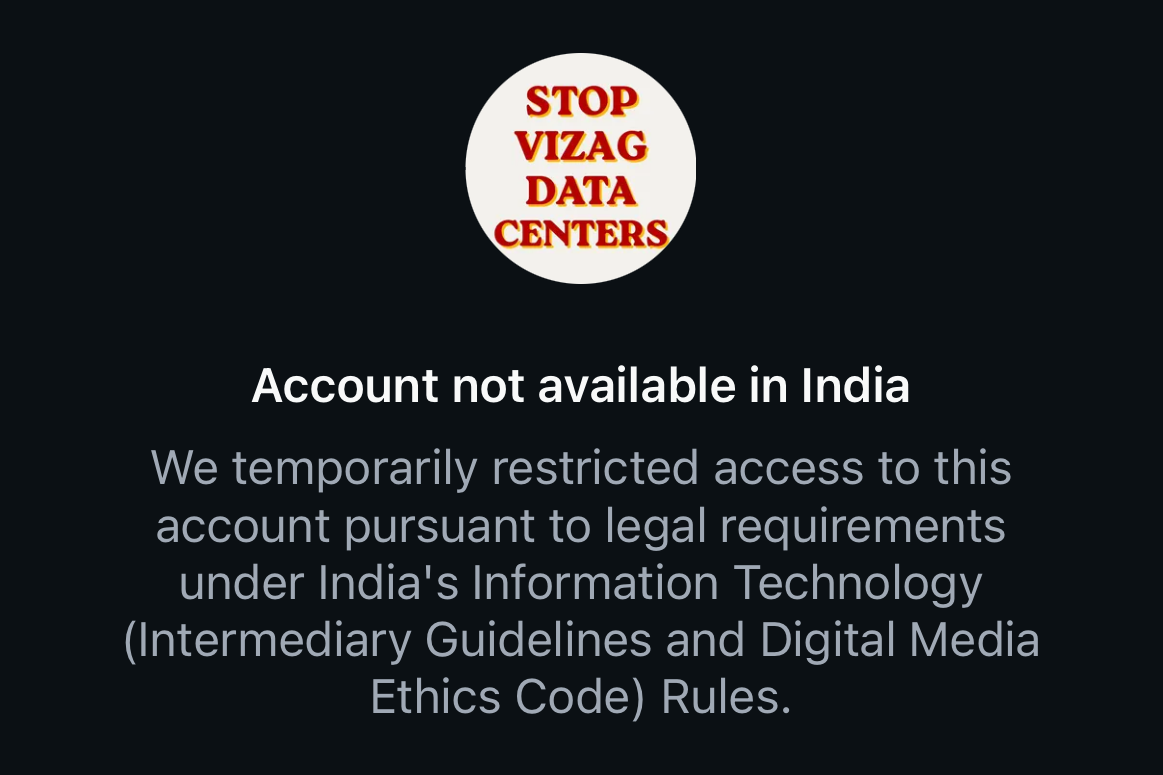
The restriction by Meta, on September 19, 2026, of the Instagram account of the citizen-led campaign ‘Stop Vizag Data Centers’ in India is deeply disturbing. The Human Rights Forum (HRF) condemns this suppression of a vital public-interest platform. This latest action follows the restriction of nine posts from the account over the preceding weeks, raising serious concerns about the systematic curtailment of public scrutiny of hyperscale data center projects in and around Visakhapatnam.
These are neither private matters nor issues of marginal concern. Since several months, online criticism of the hyperscale data centers coming up in the region has faced repeated restrictions. Time and again, the justification, invariably couched in the bland phrase “pursuant to legal requirements under India’s Information Technology Rules,’ reflects neither transparency nor accountability. As public scrutiny of these data centers intensifies, the Andhra Pradesh government appears increasingly intent on curtailing the channels through which critical questions reach the public. Rather than address legitimate concerns through open debate, it is by now abundantly clear that attempts are being made to restrict the very platforms that enable citizens to question decisions taken in the name of development.
Since its launch in July this year, the ‘Stop Vizag Data Centers’ campaign has emerged as a vibrant and influential public platform for questioning the rapid proliferation of hyperscale data centers being constructed and proposed across North Andhra. It has brought public attention to the enormous infrastructure costs and far-reaching environmental risks associated with these projects. It has raised questions about the huge demands on water, land and electricity, the handing over of precious public resources and the glaring lack of transparency and meaningful public participation. It has highlighted how critical information was being withheld thereby leaving citizens unable to properly assess the consequences of decisions that could fundamentally reshape the region. Instead of a democratic response to these questions, the government has only sought to bulldoze.
From October 2025, the State government has aggressively promoted AI data centers as major engines of development and investment. But projects presented as being in the public interest must withstand the highest degree of public scrutiny, not evade it. Development cannot mean that citizens are expected to passively accept decisions already taken, while critical information is withheld and legitimate concerns are brushed aside. Nor can criticism of government policy or corporate projects be treated as a threat to be managed through restrictions on speech.
The restriction of the entire account is particularly disturbing because the campaign’s posts dealt squarely with matters of immediate and vital public interest. The government and private companies behind these projects are taking decisions that have potentially far-reaching consequences for the region’s land and natural resources. Citizens have every right to scrutinise, question and challenge such decisions.
Nor is this an isolated instance of content suppression. We recall that numerous posts from organisations and individual accounts critical of AI data centers have been restricted on Instagram in India. These include content posted by HRF, as well as an investigative documentary by the Environmental Reporting Collective (ERC). Taken together, these repeated restrictions point to a deeply troubling pattern in which scrutiny of projects with huge consequences for the region is being squeezed out of the digital public sphere.
We believe that this ongoing censorship represents an ominous trend and goes far beyond a single Instagram account. The ‘Stop Vizag Data Centers’ campaign had, in barely two months, attracted 56 lakh views and 11,800 followers, reflecting substantial public engagement with questions concerning the social and ecological consequences of these hyperscalers. When a public-interest campaign that has reached such a large audience can suddenly be rendered inaccessible, without a transparent explanation, the message to the wider public is unmistakable which is that scrutiny of powerful interests can carry consequences. This chilling effect could extend to journalists, researchers, environmental groups and ordinary citizens who may otherwise raise questions about projects affecting their lives.
HRF demands that Meta immediately restore the ‘Stop Vizag Data Centers’ Instagram account in India. It must also clearly disclose the precise legal basis for the restriction, including the authority that sought it and the specific request made. Freedom of expression and the people’s right to participate in decisions affecting their environment, livelihoods and future are fundamental to any democratic society. Freedom of speech cannot mean merely the freedom to speak when governments or Big Tech are comfortable with what is being said. It is especially the freedom to question powerful interests, challenge official policy and oppose decisions taken in the name of development. The people of Visakhapatnam have a right to know what is being proposed in their region, what it will cost in land, water, power and environmental terms, what public resources are being committed and who will bear the costs. They have the right to debate, criticise and oppose such projects.
The Andhra Pradesh government is actively pushing these AI data center projects while claiming to welcome public debate. Yet, the repeated suppression of critical content, coupled with the government’s dismissive responses to public concerns, raises serious questions about its commitment to democratic accountability. HRF is of the view that the serious concerns thrown up by the rash of AI data centers require transparency, informed public debate and answers grounded in facts. Not evasive, contradictory and erratic responses from government functionaries, as is almost daily evident in the public domain. And it certainly does not justify curbing online speech, restricting free expression or attempts to bully.
Y Rajesh – HRF AP State general secretary
VS Krishna – HRF AP & TG Coordination Committee member
22-9-2026
Visakhapatnam