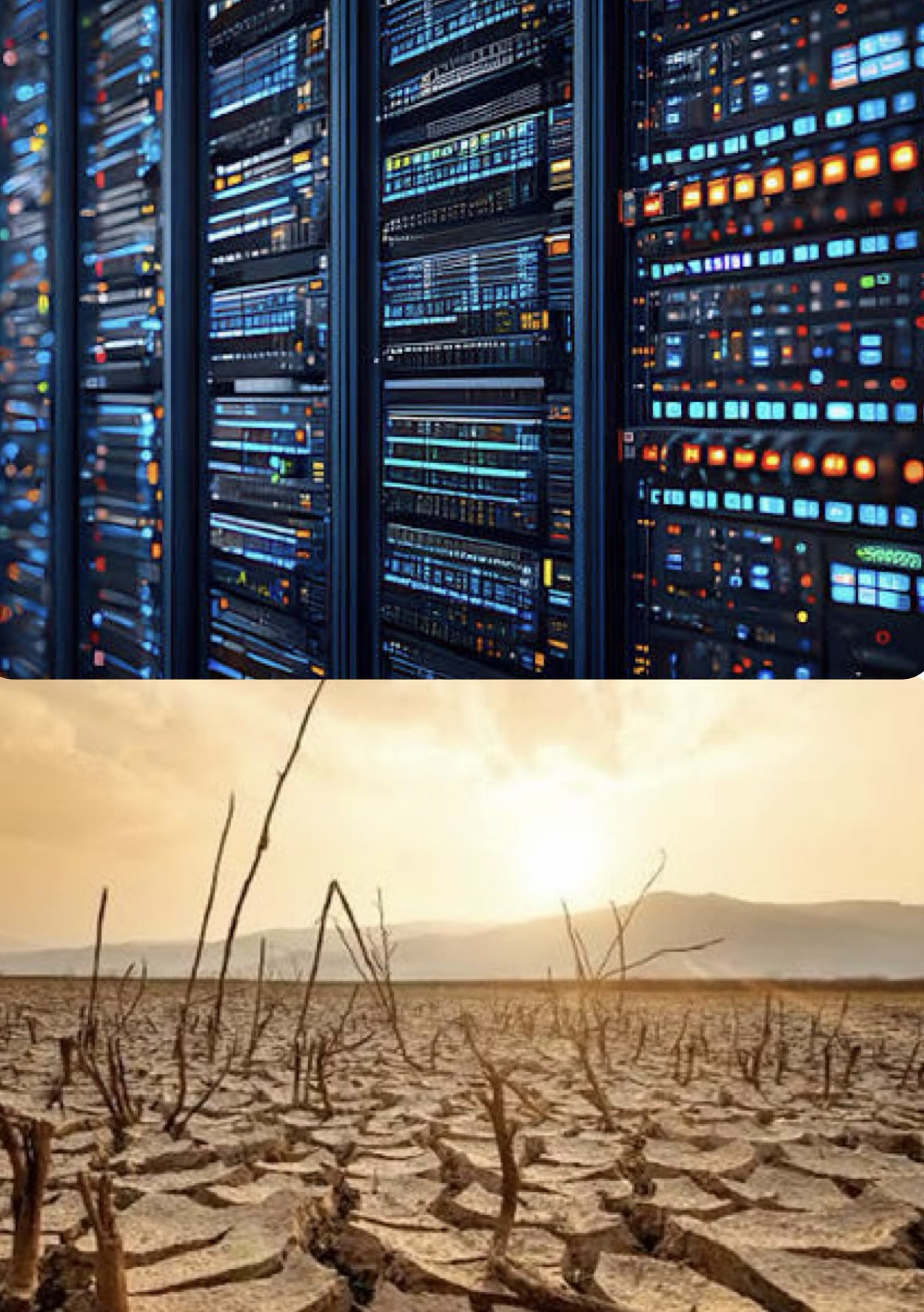
HRF demands that the Telangana government suspend the implementation of existing commitments and refrain from making any further commitments for hyperscale AI data centers until independent, publicly accessible assessments establish that their water and energy requirements will not compromise drinking water, agriculture or ecological needs. All existing and proposed projects must be assessed cumulatively, with public consultation and enforceable limits on resource use.
Chief Minister Revanth Reddy’s repeated warnings about El Nino and the looming water crisis make his government’s aggressive promotion of hyperscale AI data centers deeply contradictory. At a time when the State is facing severe water scarcity, why is the government even contemplating enormous computing facilities that will certainly intensify pressure on already-stressed water and power resources?This course is truly imprudent.
The Chief Minister himself has warned that there will be no water for agriculture in the coming months, asking farmers to defer a crop cycle so as to conserve water for drinking purposes. He has gone further, cautioning that even the availability of drinking water itself may be difficult to guarantee. Meanwhile, according to reports, the Hyderabad Metropolitan Water Supply and Sewerage Board has declared a water emergency.
If the government cannot ensure water for agriculture or even guarantee adequate drinking water for its people, what conceivable wisdom is there in inviting notoriously water-guzzling hyperscale AI data centers into the State? Is it that Telangana has no water for its farmers and not enough even for its people’s needs, but plenty for Big Tech? Such a grotesque inversion of priorities exposes the hollowness of the government’s claims to be acting in the public interest.
Hyperscale AI data centers are no ordinary industrial establishments. Their enormous computing loads demand substantial electricity and sophisticated cooling systems, which can consume significant quantities of water. Their total water footprint also includes the water used to generate the electricity they require. The actual impact depends on cooling technology, operating conditions and the sources of water and electricity. HRF is of the view that these impacts must be independently assessed rather than obscured by corporate assurances.
The government may invoke water recycling, treated wastewater and water-neutral designs to justify these projects. But such claims cannot substitute for transparent assessments of actual consumption, seasonal water availability and competing needs. Nor should promises of investment and technological prestige take precedence over the basic needs of people and the protection of local ecosystems.
The power demands of hyperscale AI data centres are equally concerning. At a time when Telangana, which is not a power surplus State, faces mounting pressure on its power supply, committing enormous amounts of electricity to these facilities risks aggravating existing constraints and competing with the needs of households, agriculture and other productive sectors. Farmers are already facing supply disruption during harvest. Yet the government plans 5 GW of AI Data centers by 2029 which run round the clock and are promised dual-grid supply. The government must explain how it proposes to meet these additional demands without compromising the State’s wider energy needs.
We fail to understand what public interest is served by committing scarce land, water and electricity to infrastructure primarily serving the computing needs of large domestic and global technology corporations. Also, the government’s tall claims of economic benefits must be weighed against the very limited permanent employment such capital-intensive facilities generate. What is more, it will be the local people who will be left to bear the environmental costs of these destructive behemoths.
The equitable distribution of scarce water resources is a fundamental responsibility of the State. The government cannot warn farmers of impending hardship and acknowledge the uncertainty of drinking water supply while rolling out the red carpet for industries whose resource demands are exceptionally high. Such a policy raises serious questions about whose interests the government is prioritising and at whose expense.
It is imperative that people’s basic needs take precedence over the expansionist ambitions of Big Tech. In a water-stressed State, the question is not merely how sustainably hyperscale AI data centers can be built, but whether their establishment is justified at all.
VS Krishna
S Jeevan Kumar
HRF AP&TG Coordination Committee members
27-10-2026
Hyderabad